There is a specific kind of afternoon that every creative person knows. The project that matters is open in front of you. The deadline is real. And somehow you end up reorganizing your workspace, sketching something completely unrelated, or doing anything except the thing you sat down to do.
The easy explanation is discipline. You don’t have enough of it. Try harder next time.
The accurate explanation is more interesting, and considerably more useful.
What your brain is actually doing
When you face a high-stakes project, your brain’s threat detection system fires before you’ve consciously registered a problem. A commission with a client waiting. An exhibition with a deadline. A piece of work that someone will evaluate and form an opinion about. The brain processes that evaluation risk the same way it processes physical danger: as something to move away from.
So it moves away. Not because you’re undisciplined. Because it’s wired to.
The redirect that follows, toward the personal sketch, the studio reorganization, the smaller completable thing, isn’t laziness. It’s your nervous system buying time until it feels safe enough to engage. Neuroscientists call the moment the emotional system overrides the rational one a limbic hijack. You don’t decide to avoid the work. The avoidance happens before the decision.
Understanding that is the first reframe. You are not failing to work. Your brain is doing exactly what brains do when they perceive a threat. The question is what you do with that information.
The difference that changes everything
Not all wandering is equal. This is the part most productivity advice misses entirely.
Passive procrastination is what most people picture when they think about avoidance. Uncontrolled, guilt-driven, going nowhere in particular doom scrolling. You end up somewhere you didn’t choose, doing something that doesn’t feed anything, and you feel worse about the original project than you did before you left it.
Active procrastination is something else. It’s a deliberate step away, with an awareness of what you’re stepping away from and an intention to return. Research consistently shows that people who procrastinate actively, on purpose and with a plan, tend to have better creative output, higher confidence in their work, and more sustainable practices than people who either grind without breaks or drift without direction.
The distinction isn’t about the task you wander toward. It’s about whether the wandering has any consciousness behind it.
And here’s the finding that reframed things for me personally: studies on creative procrastination have found that moderate wandering, spending roughly a quarter of your working time on deliberate detours, produces measurably better creative output than either heavy avoidance or unbroken focus. Not marginally better. Significantly better.
Your brain needs the detour. The detour is part of the process. The only question is whether you’re taking it on purpose or being taken by it.
What happens when you step away
There’s a reason the best ideas arrive in the shower, on a walk, or in the middle of an unrelated sketch. It’s not coincidence nor is it magic.
When you step away from a demanding problem, your conscious mind disengages. Your brain doesn’t. A network of regions that researchers call the Default Mode Network becomes active during rest and low-demand tasks. This is the same network involved in creative insight, memory consolidation, and making unexpected connections between things that don’t obviously belong together.
The personal sketch you draw while avoiding the commission is giving your unconscious the conditions it needs to work on the commission without you getting in the way. The solution that appears when you return, the one that feels like it came from nowhere, came from the twenty minutes you spent doing something else.
This is what psychologists call incubation. It’s one of the most replicated findings in creativity research and one of the least talked about in conversations about productivity, probably because it looks like doing nothing from the outside.
It isn’t doing nothing. It’s doing something your conscious effort can’t do for itself.
Making the wandering work
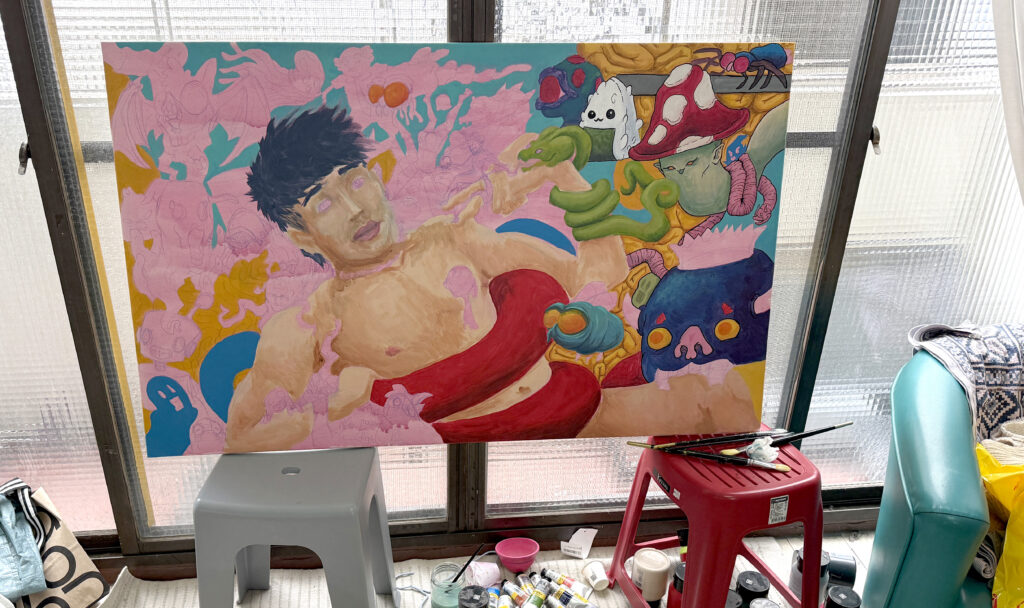
Here’s what it looked like in practice for me. I had a large, complex project with real stakes and a timeline: a solo exhibition. The kind of project where the goals are real but the path to them is long, uncertain, and mostly invisible from where you’re standing. Every time I sat down to work on it, my brain went looking for an exit.
On one occasion, what it found was a website that needed rebuilding and a creative challenge I’d been meaning to develop. Both were real priorities. Both had clearer variables, more defined finish lines, and a more legible connection between effort and outcome. The exhibition was a cave with no obvious path through it. The website and the challenge were detours with clearly marked exits.
So that’s where the energy went. And the tension I felt wasn’t just frustration at my own inconsistency. It was information. My brain wasn’t refusing to work. It was telling me something about the difference between a task it could engage with and a task it couldn’t yet find a way into. The work I produced during that period, a rebuilt site and a fully developed challenge that now sits at the center of what I’m building, wasn’t avoidance. It was my process finding a foothold while the harder thing waited. Both needed to exist. The order they arrived in was the order my brain could manage.
Stanford philosopher John Perry coined the term structured procrastination for the system that makes this intentional. The principle is simple: put the most important, most aversive task at the top of your list. Everything else becomes a way of avoiding that top item. Because your brain needs something to flee from in order to feel motivated to do anything at all, having a genuinely intimidating task anchoring the list keeps the avoidance engine running productively all day. You avoid the commission by finishing the personal sketch. You avoid the personal sketch by organizing your reference folder. Nothing is wasted. The avoidance has somewhere useful to go. Think of this as reverse engineering the principle of eating the frog first, a common productivity hack that aims at getting a detestable task out of the way early.
And It sounds almost too simple. It works because it works with the brain’s actual wiring instead of against it.
A few things worth trying if any of this resonates:
Before you sit down to the hard project, complete one small thing with a clear finish line. A quick sketch, a single reference image filed away, one email answered. The sense of completion triggers momentum that lowers the activation energy for the harder work. This is particularly useful if you struggle with ADHD like I do—get that dopamine flowing.
When you step away from the hard project, step away completely. The productive version of a detour is a full transition, not restless flitting between tasks. Give the other thing your actual attention. That’s what allows the unconscious to work on what you left behind.
Name the specific thing you’re afraid of before you sit down. Not “I’m anxious about this project” but “I’m afraid the client won’t connect with the style” or “I’m afraid this won’t reach the standard I know I’m capable of.” Naming the threat engages the rational part of your brain and partially disarms the avoidance response before it fires. It takes about thirty seconds and it works more reliably than most productivity systems three times as complicated.
The detour has information in it
Most creative blocks aren’t blocks. They’re your brain refusing to pretend it can do something it isn’t ready to do yet. The wandering that follows isn’t wasted time. It’s reconnaissance.
Pay attention to what you make when you’re supposed to be making something else. Not to judge it against the thing you avoided, but to understand what your brain was actually doing while you were gone. The detour is data. The pile is evidence of a practice.
The goal isn’t to eliminate the wandering. It is to learn to wander on purpose.
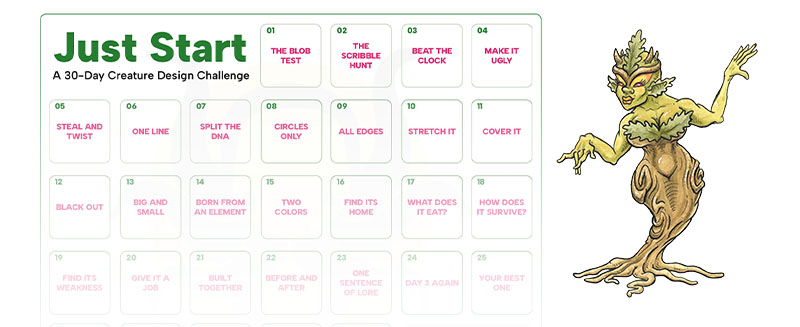
If you’re looking for a way to build that kind of structured daily practice, the Just Start Challenge is a free 30-day creature design prompt series built around exactly this principle: one completable task per day, a clear finish line, and a low-stakes way back into the work.
Stay creative,
Thai
A New Year, A New … Site
True to the cheesy headings, I’m changing things up here on my site.
I’ve felt like the OctopusHive as a travel blog was never gonna make it. First off, I don’t travel enough to get material and I’m kinda boring as all of the adventure stuff goes. I just like eating, chatting, drawing, and playing games. Sure, I could make that interesting, maybe, but clearly it wasn’t interesting enough to me to even try.
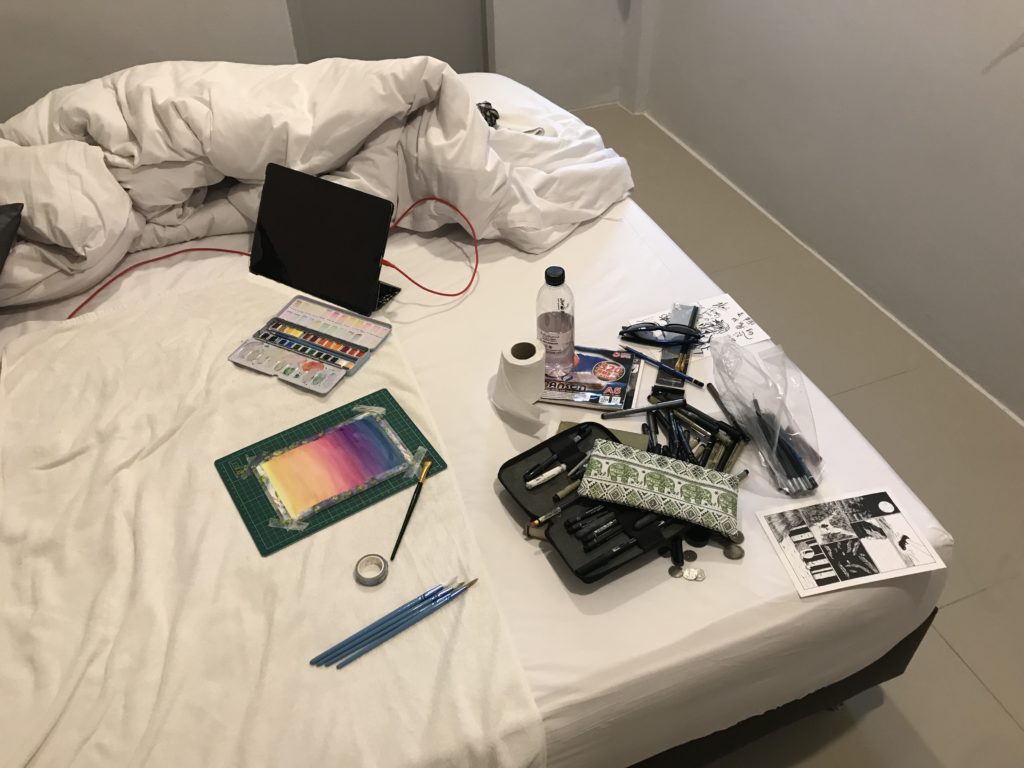
Going into 2020, I feel like a new man. I’m about to finish my first year living in China and I feel like I’ve grown by leaps and bounds. I’m doing more art, I have my own place, I making all new friends, I’m on the verge of being bilingual (It’s a blurry line some my say trilingual, but I’d feel weird claiming that one.)
All that said, this site is going to be my, hopefully not too vain, place to give back to the internet. I’ve self-taught myself so many things from YouTube, like knitting, kombucha brewing, watercolor, pickling vegetables, and folding little paper stars. Forums, blogs, and online-course sites have been my go-to for years.
I don’t have one thing I’m terribly good at. So, I’ll just be throwing stuff up here that I’ve found, figured out, created, or even just have questions about.
There’ll probably be a store at some point to off-load some of my Art and make enough money to justify the time-money expense of maintaining this site. And if it gets serious enough, I’ll probably have to be more professional about stuff and separate out my content. But I can worry about that later.
What to expect in the future
Most of my posts will be less personal, I think. Like I said, my goal is to give back. You can look for content like:
- Improv Cooking (For One) – definitely a niche interest if there ever was one
- Expat living – It’s another world that requires some creativity to survive
- Language learning – I’ve learned tons of do’s and don’ts I want to share
- Art – ’cause that’s my thing
- etc. – Time will tell what makes the cut here, I may even muse about things from time to time.