
PREVIOUS CREATURENEXT CREATURE
Specimen — OCT-0034
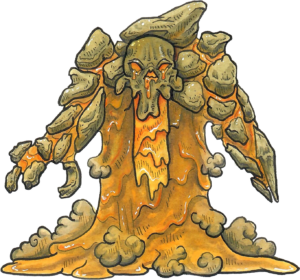
Pyroclastic Golem
Also known as: Ashmason, Cinderback, The Wall on the Mountain
“I thought it was crying. Then one of the drops landed on the iron rail and went straight through.”
—Quarry apprentice’s journal
“It rejected every dressed stone we offered. In the end it took the old mounting block from outside the inn. Apparently that was the right shape.”
—Town mason’s account
The quarry town keeps a row of basalt posts between its houses and the mountain. Most years, they serve as hitching posts. When ash starts falling, the townspeople clear the line. The Pyroclastic Golem will be coming down to see which stones are still standing.
The golem was built to raise barriers that steer lava away from the town. It gathers loose rock into its molten shoulders and carries it downhill, laying one slab at a time. Each completed barrier gets a shallow handprint on its uphill face. Quarry workers still mark their own repairs the same way.
Once, after a long quiet spell, the town built a storehouse in an old diversion channel. The golem dismantled it during the next eruption. It left the jars of lamp oil lined up on the road, then used the foundation stones to finish the wall.
Volcanic slopes, old lava channels, and quarries near active vents. Between eruptions, the golem rests in hollows where heat still rises through cracks in the rock. From a distance, its cooled shoulders resemble a pile of discarded quarry stone.
The golem moves on a broad, flowing base, bracing itself with its stone-clad arms on steep ground. It tests slabs by gripping them until the outer surface heats. If a slab cracks, it drops the pieces and moves on.
When a joint cools and stiffens, the golem lets the crust break away and draws hot material up from its core. This sends up a burst of ash and hot grit. A golem that has stood still long enough to look safe can be especially dangerous when it starts moving again.
Created for Fire Element Week of Creatuanary 2024. The design sets a skull-like face and heavy slabs of rock against a flowing orange body, with ash curling around its base and molten drops falling from its eyes.
Real-World Origins: The golem comes from Jewish mystical and folkloric traditions, in which a figure made from clay or earth may be brought to life through sacred letters. The volcanic body and its work protecting the quarry town are original fantasy. Jewish Museum Berlin