


Dungeon Performance Review
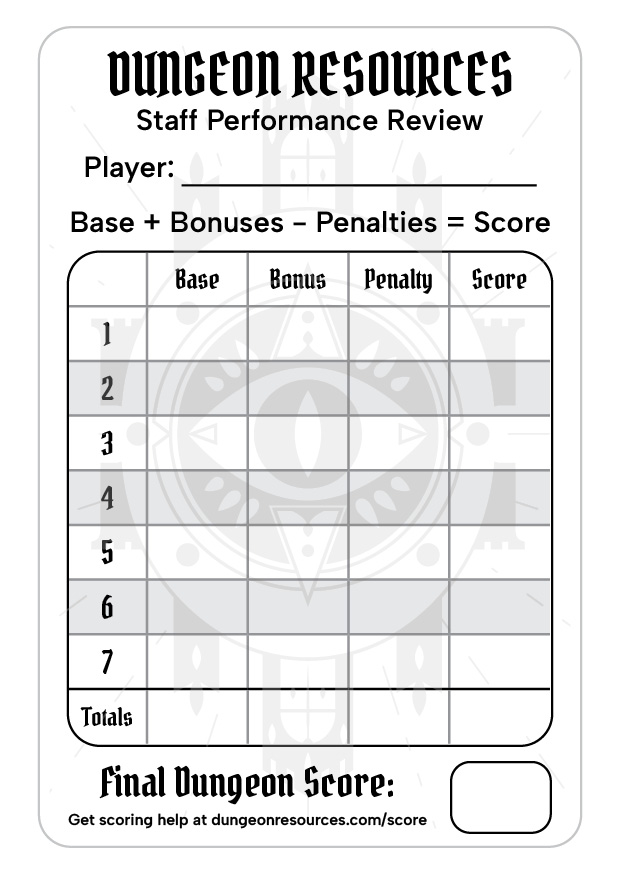
Download a printable score card
- Prints four to a page
- Printer friendly black and white
Scoring Rules and Rule Explanations
Total score = base power + bonuses − penalties
How do I score my dungeon?
Reveal your final seven monsters. For each card, start with its base power and apply its printed interaction once. Add the seven card scores together. The highest total wins; tied players share the victory.
Which cards count toward my interactions?
Only the seven monsters in your final lineup. Cards in the deck, the discard pool, and other players’ lineups don’t count. Each interaction adjusts the score of the card it’s printed on.
What’s the difference between a job and a creature type?
A job is what the monster does in the dungeon: Guardian, Hunter, Trickster, Keeper, or Mini-Boss. A creature type is what the monster is: Beast, Construct, Horror, Humanoid, Pest, or Spirit. Fire Chicken is a Trickster and a Beast. It counts toward both when an interaction asks for the relevant trait.
Which cards count toward my interactions?
The point of using dummy text for your paragraph is that it has a more-or-less normal distribution of letters. making it look like readable English.
Does a card count itself?
Yes, if it matches what the interaction asks for. The words “other” and “another” exclude the card you’re scoring. For example, Restless Drinkers gets +2 per other Pest. If your lineup has three Pests including Restless Drinkers, it gets +4 and scores 5.
What happens if a bonus condition isn’t met?
The card gets no bonus and keeps its base power. For example, Ruby Golem scores 11 with a Keeper in your lineup and 7 without one.
How do “only” and “no” work?
Check your whole final lineup. If Master Moth is your only Hunter, it gets +6. If there’s even one other Hunter, the bonus doesn’t apply. Likewise, “no Keeper” means there are zero Keepers in your lineup.
Do both monsters get a bonus from a named partnership?
The card that lists the bonus gets the points. For example, Norbit gets +20 if Spirit Whale is in your lineup. Spirit Whale scores its own interaction as usual; it doesn’t get a second partnership bonus.
Can a monster score less than zero? Does it still count?
Yes to both. Subtract the full penalty, even if the result is negative. A monster with a zero or negative score still keeps its job and creature type, so it can still help or hinder its coworkers.
Do I need the online calculator?
No. You can score with pencil and paper or use the printable score card for a bit more guidance.
To check your arithmetic or see a breakdown for each monster, use the Dungeon Resources Score Calculator.
Does Caller Bird count Beast even though it’s a Beast itself?
Yes, if at least one of your other cards is a Beast. Ignore Caller Bird itself, then count each distinct creature type among the remaining six cards. If Fire Chicken is there, Beast counts for +2. A second Beast doesn’t add another +2. If Caller Bird is your only Beast, Beast doesn’t count.
Dungeon Resources Score Calculator