
PREVIOUS CREATURENEXT CREATURE
Specimen — OCT-0019
Dryad
Also known as: The Grove’s Remembering
“She asked whether the miller’s daughter had recovered. There has been no mill here for a hundred years. I told her I would make inquiries.”
—Woodland survey journal
“I asked permission to take a fallen branch. She pointed to another. Mine had beetles in it.”
—Basket maker’s account
“We agreed on the boundary in winter. I should have asked whether the agreement included spring.”
—Letter from an adjoining landowner
The grove’s oldest boundary stone stands several paces inside its youngest tree. Surveyors regard this as a problem. The Dryad seems pleased with the arrangement.
She remembers the clearing before it was a road, the road before it was abandoned, and the orchard planted by people whose descendants now call it wild. Visitors seeking directions sometimes receive an accurate account of where a village used to be.
Those living nearby bring her news as well as offerings. A birth, a marriage, or a change in the ownership of the neighboring fields may interest her more than a bowl of honey. Such conversations proceed slowly. She often asks after someone whose name survives only on a weathered gravestone.
Her favor is expressed through practical things: shade over a resting place, roots holding a washed-out bank, fruit falling within reach. Her displeasure is equally specific. A woodcutter who damaged a nesting tree reportedly spent the following spring removing seedlings from his chimney.
Established woodland, old groves, and the wooded margins of long-inhabited places. Deep soil, undisturbed roots, and a healthy canopy support her presence.
She may remain where the surrounding forest has vanished, preserving a small stand of trees among fields or buildings.
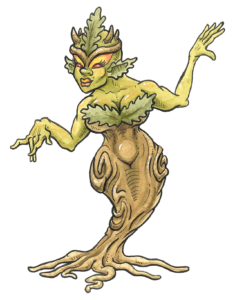
The Dryad spends long periods rooted in place, responding to changes in light, moisture, and nearby activity. Her upper body remains expressive even while the rest appears indistinguishable from wood.
Movement involves loosening and repositioning her roots, a deliberate process that leaves the soil surprisingly little disturbed. When listening closely, she sometimes places a hand against a neighboring trunk.
She tolerates gathering that leaves the grove healthy. Wasteful cutting, damage to roots, and disturbance of nesting animals draw a more immediate response.
Created for Earth Element Week of Creatuanary 2024. The design combines a green humanoid upper body with a rooted wooden trunk, leaf-shaped adornments, and a crownlike arrangement of pointed growths.
Dryads are tree and woodland nymphs from Greek mythology, particularly associated with oaks. Related traditions describe hamadryads, whose lives are bound to individual trees. Source: Theoi’s collection of classical references
This artwork interprets the Dryad as visibly botanical, with a wood-grained lower body, spreading roots, and leafy features. The grove’s history, specific behaviors, and field-note quotations above are original bestiary fiction.