
PREVIOUS CREATURENEXT CREATURE
Specimen — OCT-0030
Kalavinka
Also known as: Kalaviṅka (Sanskrit), Karyōbinga (Japanese), The Twin-Voiced Bird (bestiary epithet)
“One face watched the conductor. The other watched the boy who had come in late. It was the boy’s tune they picked up.”
—Music teacher’s notebook
“From the boat I heard the horn clearly. My sister on the terrace heard only the singing. We argued about it all the way home.”
—River crossing journal
At the hilltop music school, students are taught to leave a full breath between the verses of a song. On certain mornings, the Kalavinka fills it.
One of its two voices takes up the last note a singer has left hanging. The other answers with a phrase of its own. The golden horn sounds only after both voices have fallen quiet, and its note carries all the way to the river. Boat crews downstream sometimes hear the end of a performance that no one on the hill knew had begun.
For years, the school kept a book of the phrases the bird had added. Students practiced them diligently, hoping to entice it back. It was a groundskeeper who finally drew it down to the courtyard: she was humming half a tune while she swept and couldn’t remember how the rest went.
High garden walls, wooded ridges, and terraces overlooking water. The Kalavinka favors sheltered perches with open air below, where it can drop into flight without catching its long tail feathers.
While perched, one head often watches the surroundings while the other listens. Both can sing at once, sustaining separate melodies even as the bird shifts its footing or takes wing.
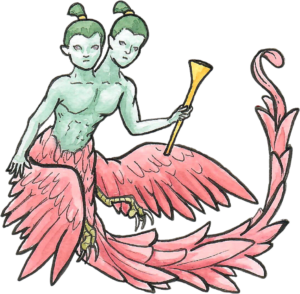
It carries its horn in one hand and occasionally tests a room with a short blast before singing. In a space with a strong echo, it will wait for the sound to die away completely.
Created for Creatuanary 2023. This interpretation gives the Kalavinka two human heads, coral-pink wings, a sweeping tail, and a small golden horn.
Real-World Origins: The Kalaviṅka is a bird of wondrous song associated with the Pure Land in Buddhist tradition. Buddhist art often depicts it with a human head and upper body, a bird’s wings and legs, and a musical instrument. The two-headed design is a feature of this rendition; some Buddhist paintings distinguish the single-headed Kalavinka from a separate two-headed bird, the jīvajīva. Nara National Museum’s Shōsō-in glossary · International Dunhuang Programme
The music school, encounters, and field-note quotations are original bestiary fiction.