
PREVIOUS CREATURENEXT CREATURE
Specimen — OCT-0027
Ruby Golem
Also known as: Red-Eye Mason, Gemvein Sentinel, The Patient Chisel
“It stopped because the replacement beam was shorter than specified. The difference was less than my fingernail. The ceiling above it justified the objection.”
—Restoration engineer’s notebook
“Someone told it to keep the passage clear. We found three centuries of fallen rock stacked outside in remarkably tidy rows.”
—Mine survey report
“The eye brightened when I thanked it. This may have been a charging cycle. I thanked it again.”
—Workshop assistant’s journal
The first instruction given to a newly awakened Ruby Golem is traditionally simple: lift a stone, cross a room, or turn toward a light. Its maker then waits for every gemstone in its body to answer.
A delayed response can indicate a poorly seated crystal. An unexpected response may require revisiting the entire design.
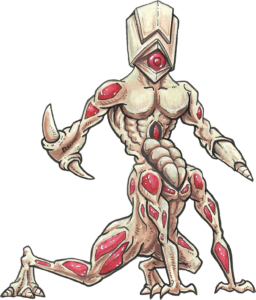
The rubies form a network through which the animating enchantment passes. Each movement travels visibly through them, beginning with a gleam in the central eye and descending through the torso into the limbs. Skilled makers can diagnose a damaged joint by watching where the light hesitates.
Ruby Golems were built for work in confined excavations. Their pointed forelimbs split seams and brace unstable passages, while their widely spread feet distribute weight over broken ground.
Abandoned specimens sometimes continue maintaining tunnels long after a mine has closed. Explorers follow the sound of patient chiseling to find fresh supports beneath ceilings no living worker remembers inspecting.
Gem-bearing caverns, worked quarries, underground vaults, and the remains of workshops capable of maintaining enchanted constructs.
Inactive specimens often stand within wall recesses, their pale bodies difficult to distinguish from unfinished carvings until a ruby catches the light.
Ruby Golems perform assigned work with deliberate precision, pausing when conditions no longer match their instructions. Such pauses can last years.
Their multiple supporting limbs allow them to brace against walls while working a pointed forearm into stone. The central eye tracks the task closely, shifting toward nearby movement only when it obstructs the work.
Damaged specimens may repeat an incomplete action. A tapping sound from an abandoned shaft can therefore indicate either ongoing repairs or a golem attempting, indefinitely, to finish one last cut.
Created for Earth Element Week of Creatuanary 2024. The Ruby Golem combines a pale, sculpted body with embedded red gemstones, a single ruby eye, pointed forelimbs, and multiple angular supporting legs.
Real-World Origins: The golem comes from Jewish mystical and folkloric traditions, in which a humanlike figure formed from clay or earth may be animated through sacred letters or names. Source: Jewish Museum Berlin
This gemstone-powered, many-legged interpretation is an original fantasy variation. Its construction, working practices, and field-note quotations are invented for this bestiary.