
PREVIOUS CREATURENEXT CREATURE
Specimen — OCT-0012
Nuckelavee
“I thought it had stopped to rest. Then the hand came around the wall.”
—Account collected from a coastal shepherd
“The burn scarcely covered my soles. Across it, those fingers opened and closed until morning.”
—Road traveler’s testimony
“My brother watches the sea when we walk home. I watch the ditches. Between us, we have become very difficult company.”
—Resident of a shore settlement
Along the shore road, distances are measured in crossings. One burn before the pasture, another below the ruined mill, a third beyond the bend. After dark, knowing the distance home matters less than knowing the distance to running water.
The Nuckelavee comes inland from the sea, bringing a heat that sits strangely in the cold coastal air. Behind shuttered windows, people listen for the uneven rhythm of its passage: heavy impacts interrupted by the scrape of long fingers.
Its appearance is followed by anxious inspections of fields and livestock. Every wilted stalk becomes evidence; every coughing animal renews an argument about who saw what upon the road.
When drought reduces the burns to threads, neighbors deepen their channels by hand. Children sometimes ask whether so little water could stop something so large. The adults continue digging.
Rocky shores, coastal tracks, and low farmland within reach of the sea. Narrow routes between saltwater and inland lochs are particularly dreaded, offering travelers little room to avoid an approaching figure.
Freshwater crossings form boundaries to its inland movements.
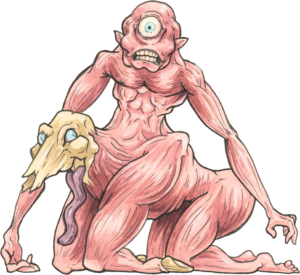
The Nuckelavee advances with an awkward coordination between its fused forms. Its long arms extend well beyond the apparent reach of the lower body, making narrow escapes more difficult than its gait suggests.
It pursues those it encounters on land, reaching across obstacles rather than slowing to negotiate them. At running freshwater, its advance stops abruptly.
Observers disagree about whether the two faces attend to different things. Several accounts describe the upper eye remaining fixed on a traveler while the lower head turns toward the sound of water.
The Nuckelavee is a sea monster from Orkney, Scotland. Folklorist Walter Traill Dennison recorded it as a skinless, horse-and-rider-like being associated with crop blight, disease, and drought. In his account of the traveler Tammas, freshwater repels the creature, and crossing a stream allows the man to escape.
This artwork reinterprets its combined human and equine anatomy. The shore-road customs, specific observations, and field-note quotations above are original bestiary fiction.
Created for Creatuanary 2025, inspired by the Nuckelavee of Scottish folklore. The design emphasizes exposed musculature, elongated arms, a skull-like lower face, and a single eye in the upper figure.