
PREVIOUS CREATURENEXT CREATURE
Specimen — OCT-0013
Ittan-momen
Also known as: The Wandering Bolt
“I took it down from the washing line three times. On the fourth, I noticed it was putting itself between me and the door.”
—Account from a village household
“The red side passed first. Then the white. Then the red again. There was far more cloth than the lane had room for.”
—Evening watch notebook
“It lay perfectly folded on the counter. I nearly sold it. In my defense, business had been slow.”
—Cloth merchant
n villages along the old road, laundry is counted twice: once when it is hung, and again before sunset. An extra length of cloth is considered more troubling than a missing one.
The Ittan-momen drifts above paths and rooftops with the apparent aimlessness of windblown fabric. It catches on branches, hangs from eaves, and lies folded across walls. These pauses have tempted more than one helpful passerby to gather it up.
People disagree about whether it understands clothing. A weaver once reported finding it wound neatly around an empty loom. An innkeeper insisted it spent an entire evening attempting to enter a sleeve.
Both agreed that it became considerably less curious when someone turned their back.
Some households tie short scraps to their gates before dusk. Their fluttering offers a useful warning: when the scraps hang still and something larger continues moving, it is time to go indoors.
Village outskirts, narrow lanes, wooded paths, and the spaces above courtyards and drying lines. It favors places where hanging cloth provides cover and fading light makes its outline difficult to judge.
During daylight, a motionless specimen could easily be mistaken for discarded fabric.
Ittan-momen travels by rippling and twisting its body, changing direction without an obvious dependence on the wind. Its loose ends explore gaps and projections, sometimes anchoring briefly before the rest of the body follows.
When approaching a person, it may circle at a distance before sweeping toward the head or neck. Once wrapped, its folds tighten with surprising strength.
The face becomes distorted or disappears as the cloth turns. Observers should not assume that the absence of visible eyes means its attention has shifted elsewhere.
Ittan-momen (一反木綿) is a Japanese yōkai associated with the Ōsumi region of Kagoshima Prefecture. Its name refers to a bolt of cotton cloth. Local accounts describe a clothlike being that flies at night and attacks people; some describe it wrapping around the head or neck and obstructing breathing.
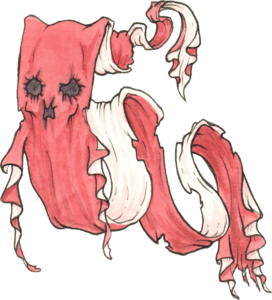
This artwork reimagines the usually white cloth in red and white, with a dark, frayed face. The village customs, additional behaviors, and field-note quotations above are original bestiary fiction.
Created for Creatuanary 2025, inspired by the Ittan-momen of Japanese folklore. The design features a long, curling cloth body, contrasting red-and-white surfaces, ragged edges, and a masklike face.