
PREVIOUS CREATURENEXT CREATURE
Specimen — OCT-0015
Swamp Spector
Also known as: The Wandering Mire, Old Bogface
“We spent an hour discussing whether it was an omen. The frog on its cheek spent that hour eating mosquitoes.”
—Marsh survey journal
“It waited while I emptied the bucket. Then it waited while I checked beneath the boat. I found one more tadpole.”
—Fisher’s account
“The snake has accompanied it on all four sightings. I hesitate to call it a familiar. It may simply dislike swimming.”
—Wetland observer’s notes
Marsh guides recognize certain pools by the voices of their frogs. When an entire chorus moves overnight, they know the Swamp Spector has passed through.
It drifts between dwindling ponds and deeper water, collecting a peculiar following. Small creatures climb into its folds or swim beneath it, carried over mudbanks and stretches of exposed ground. Whether it gathers them deliberately remains uncertain. It has been observed waiting beside a stranded pool long after the first passengers were aboard.
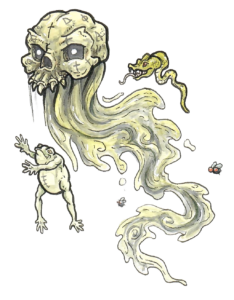
The markings across its head attract considerable scholarly attention. Some resemble letters, others tally marks or the scars left by roots pressing against buried stone. Copies seldom agree. One researcher spent a summer attempting to translate them before a boatman pointed out that he had been recording a different face each week.
Local fishers leave flooded baskets beside drying pools. By morning, both basket and inhabitants may have vanished. The baskets occasionally return downstream, occupied by something other than what was put inside.
Reed beds, flooded woodland, peat pools, and shallow waterways that change with seasonal rainfall. It appears most often where receding water has separated small pools from the wider marsh.
Its passage leaves a damp trail through vegetation, sometimes linking stretches of water that have been disconnected for years.
The Swamp Spector travels close to the ground or water, its trailing body gathering around obstacles before flowing past them. Small animals can rest within its folds without visibly sinking through.
It pauses frequently, particularly near splashing or repeated animal calls. Human attempts to attract it with imitations have produced mixed results and several unwanted snakes.
When disturbed, it spreads into a low bank of greenish mist. Its passengers scatter, and the skull-like head is usually the last part to disappear.
Created for Water Element Week of Creatuanary 2024. The Swamp Spector features a marked, skull-like head above a flowing green body, accompanied by a frog, a snake, and several flies.